
 Keith
KeithImagine doing something slightly radical.
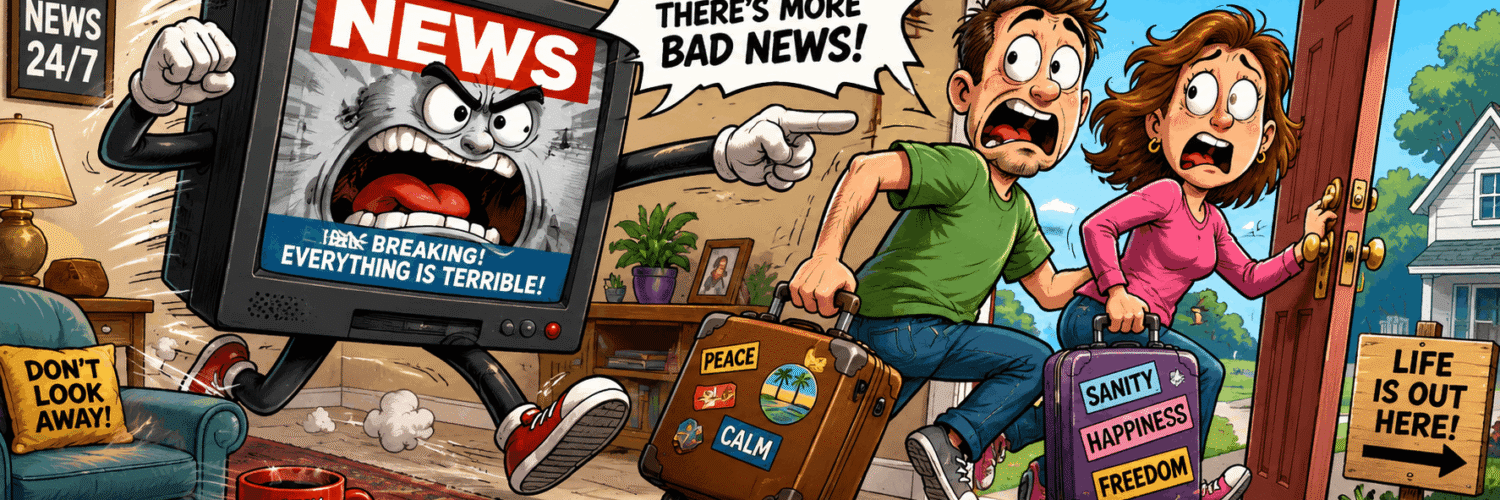
For the next 30 days, you stop watching the news.
No breakfast news.
No evening news.
No news notifications flashing across your phone.
No checking the headlines because you’ve got five minutes to spare.
And absolutely no lying in bed at 11:43 p.m. reading about wars, political arguments, economic disasters, violent crime, and the latest terrifying thing that’s apparently going to wipe us all out by Thursday.
Thirty days.
Could you do it?
More importantly…
What would happen to you if you did?
We Consume Far More Bad News Than We Realize
News has changed.
There was a time when you might read a newspaper in the morning or watch a television bulletin in the evening.
Then it was finished.
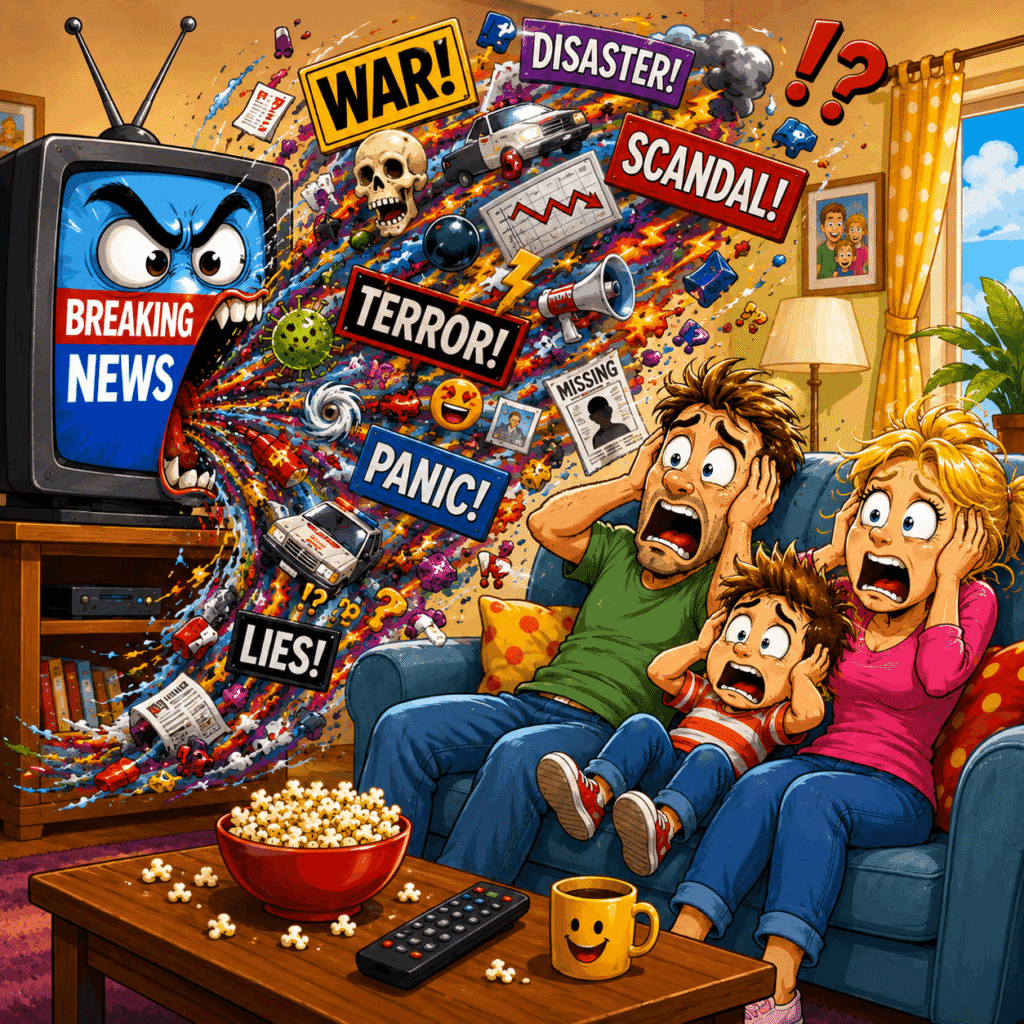
Today, the news never ends.
It’s on television.
It’s on your phone.
It’s on social media.
It’s in your email.
It’s appearing in notifications.
It’s waiting for you every time you open a browser.
And there’s a reason so much of it is negative.
Bad news gets attention.
A headline saying:
“Everything Is Basically Fine Today”
Probably won’t generate many clicks.
Fear does.
Anger does.
Conflict does.
Disaster certainly does.
Which means the modern news business has become extremely good at finding things for us to worry about.
And then delivering them directly to us through multiple devices.
Fourteen Minutes Was Enough
Here’s where things become interesting.
Researchers Wendy Johnston and Graham Davey conducted an experiment in which participants watched just 14 minutes of television news.
Some watched predominantly negative stories, while others saw more positive or neutral material.
The results were striking.
The people exposed to the negative news reported increased anxiety and sadness.
But something else happened.
They also became more likely to catastrophize worries from their own lives.
Think about that.
The terrible event on television didn’t even have to happen to them.
Watching other people’s problems appeared to influence how they subsequently thought about their own.
And that was after just 14 minutes.
Now consider how much negative information the average person consumes over a week.
A month.
A year.
Or several decades.
Perhaps it’s worth asking whether constantly knowing everything that’s going wrong everywhere is quite as healthy as we’ve assumed.
So Let’s Try Something
I’m proposing an experiment.
Thirty days without watching the news.
Not forever.
We’re not going to move into a cave, grow an enormous beard, and communicate exclusively with passing squirrels.
Just 30 days.
There are a few simple rules.
Turn off news notifications.
Stop watching television news programs.
Don’t deliberately browse news websites.
Don’t spend your evenings doomscrolling through social media stories.
And when somebody says:
“Have you heard what happened?”
Resist the urge to grab your phone before they’ve even finished the sentence.
You are temporarily resigning from your position as Chief Monitoring Officer for Planet Earth.
The world will have to manage without you.
Days 1–3: Something Will Feel Missing
I suspect the first few days could feel surprisingly strange.
You reach for your phone.
Then remember.
No news.
You eat breakfast without somebody telling you about inflation, war, crime, political scandal, or an approaching weather system with a terrifying name.
You might even feel slightly irresponsible.
Shouldn’t you know what’s happening?
What if something important occurs?
Here’s an interesting question.
If something genuinely enormous happened, do you really think you wouldn’t find out?
If aliens landed in Trafalgar Square tomorrow morning, I’m reasonably confident someone would mention it.
You don’t necessarily need to spend several hours every day checking whether they’ve arrived.
Days 4–7: The World May Start Looking Different
Something else might begin happening after a few days.
The world immediately around you may start competing with the world on your screen.
You notice people.
You notice conversations.
You notice the weather.
You notice what’s actually happening in your street, your family, and your own life.
And here’s the strange thing.
Most of it may be perfectly normal.
The neighbor still takes the dog for a walk.
People still laugh in coffee shops.
Children still play.
Someone is planting flowers.
Someone else is planning a holiday.
Millions of people are falling in love, starting businesses, getting married, having babies, recovering from illnesses, making friends, and quietly getting on with their lives.
But none of that is particularly newsworthy.
“Couple Have a Lovely Afternoon in Brighton”
is unlikely to lead the six o’clock bulletin.
Week Two: Your Brain Gets Some Space Back
By the second week, you might begin noticing how much mental space the constant flow of information was occupying.
This is where another piece of research becomes relevant.
A study involving 179 university students investigated the psychological effects of watching a 15-minute television newscast.
Researchers measured anxiety and mood before and after the news exposure and examined whether relaxation could counter some of those effects.
Again, we’re talking about minutes of exposure.
Not hours of scrolling.
That’s what makes this fascinating.
We tend to think information simply enters our brains, gets processed, and disappears.
But emotional information can linger.
A frightening headline can still be rattling around somewhere in your mind while you’re cooking dinner three hours later.
Multiply that by hundreds of headlines and thousands of stories.
Maybe our minds aren’t designed to carry the problems of eight billion people.
Week Three: You May Discover How Often You Were Being Provoked
News doesn’t only frighten us.
It makes us angry.
Someone somewhere says something outrageous.
A politician makes a ridiculous comment.
A celebrity does something stupid.
Somebody on social media reacts.
Someone else reacts to the reaction.
Before long, thousands of people are furiously arguing with complete strangers.
And you’re sitting on the sofa thinking:
“Well, I’ve certainly got something to say about THAT.”
But do you?
Do you actually need to?
During week three of our experiment, you might start noticing something rather wonderful.
There are fewer people living rent-free inside your head.
Millions of People Are Already Pulling Away
If you’ve ever felt exhausted by the news, you’re certainly not alone.
The Reuters Institute for the Study of Journalism reported in its 2025 Digital News Report that 40% of people surveyed across its markets said they sometimes or often deliberately avoid the news.
That figure was 29% in 2017.
Something has changed.
People haven’t necessarily stopped caring about the world.
Many appear to have become overwhelmed by the relentless volume of information coming at them.
There’s an important distinction here.
Being informed is useful.
Being permanently plugged into the world’s problems is something else entirely.
Week Four: What Have You Actually Missed?
This may be the most interesting part of the experiment.
After roughly three weeks, ask yourself:
What have I actually missed?
Not what happened.
What did you miss by not knowing about it immediately?
Did your life stop functioning?
Were you unable to work?
Did your relationships collapse?
Were you unable to make important decisions?
Or did life carry on remarkably normally?
There’s an uncomfortable possibility here.
We may consume much of the news not because we need it, but because we’ve developed a habit of checking it.
And habits can masquerade as necessities.
But Here’s Where the Science Gets Interesting
There is a twist.
Research doesn’t suggest that simply avoiding news automatically makes everybody happier.
A 2022 study involving more than 800 participants investigated what happened when people took a one-week “news vacation.”
The researchers found no significant positive or negative effects on the outcomes they measured.
That’s important.
It means we shouldn’t turn this into another ridiculous internet claim:
STOP WATCHING THE NEWS AND BECOME 73% HAPPIER BY TUESDAY!
Life doesn’t work like that.
Perhaps the real benefit isn’t simply knowing less.
Perhaps it’s taking back control over what gets your attention.
That’s a very different proposition.
Day 30
Now imagine you’ve reached the final day.
Thirty days without deliberately watching the news.
Sit down somewhere quiet and ask yourself a few questions.
Do I feel calmer?
Have I worried less?
Have I been more present?
Have I spent less time scrolling?
Have I concentrated better?
Have my conversations changed?
Has my perception of the world changed?
And perhaps the biggest question of all:
Did I actually miss the news?
Your answer might be yes.
You may decide you prefer knowing what’s happening every day.
Fair enough.
But you might discover something else.
You might realize that you don’t need quite as much of it as you thought.
Maybe We Don’t Need to Know Everything
I’m not suggesting ignorance.
I’m not suggesting we stop caring about what’s happening around us.
And I’m certainly not suggesting we abandon journalism. Good journalism matters enormously.
I’m suggesting something much simpler.
Maybe we should choose when the world gets access to our minds.
Perhaps instead of checking the news fifteen times a day, once is enough.
Perhaps once every couple of days is enough.
Perhaps notifications don’t need to interrupt dinner.
Perhaps the first thing entering your mind every morning doesn’t need to be somebody else’s disaster.
And perhaps the final thing you think about before falling asleep doesn’t need to be something frightening that happened 4,000 miles away.
We have become extraordinarily careful about what we put into our bodies.
Maybe it’s time we became a bit more selective about what we let into our minds.
Thirty days.
That’s the experiment.
You don’t have to disappear from civilization.
You don’t have to throw your television through the window.
Just switch off the news.
Then see what happens.
You might discover that while you were busy watching the world…
Your own life was waiting for your attention.
P.S. If you enjoyed this article, take a look around the blog. You’ll find plenty more thoughts on money, personal development, technology, reinvention, and some of the stranger things about modern life.
P.P.S. If you’re fascinated by the hidden forces that shape our lives, you’ll love The Manifestation Code blog, where we explore manifestation, synchronicity, the Law of Attraction, and the mysteries of the universe.












Add comment